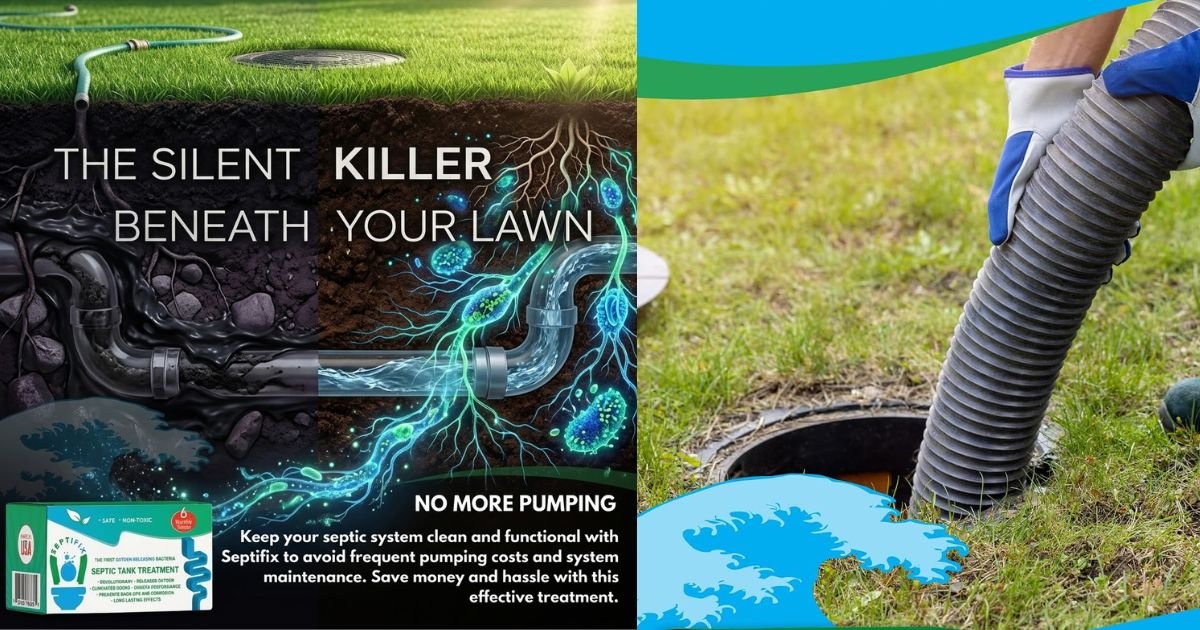
90% of homeowners use septic Tank treatments that actually destroy their drainfield. Discover the aerobic “Septifix Protocol” the elite 10% use to save $30k.
You flush. It goes away.
For most of us, that’s the entire extent of our relationship with the septic system. It’s a subterranean black box, out of sight, out of mind. Until it isn’t. Until you’re standing in your backyard, staring at a soggy, foul-smelling patch of grass, doing the terrifying mental math of what a new drainfield actually costs.
Spoiler alert: it’s in the ballpark of $30,000.
If you’ve been relying on the standard “pump and pray” method, you’re in the majority. About 90% of homeowners are. But you’re also using the wrong biological hack. The remaining 10%—the ones who never have a backup and sleep soundly through the night—treat their system like a living, breathing ecosystem. They know that true longevity isn’t about just removing waste. It’s about optimizing the microscopic war happening inside the tank.
If you’ve been reading every septifix review online trying to figure out if there’s a better way, you’re asking the right questions. This is the definitive guide to the septic tank treatment paradigm shift. We’re going to dismantle the chemical traps, expose the limitations of standard biological additives, and reveal the aerobic amplification protocol that is quietly saving homeowners from financial ruin.
The Hidden Biology of Your Septic System: Beyond the “Black Box”
To understand why your system might be failing, you have to stop looking at it as a pipe and start looking at it as a battlefield. The efficiency of this subterranean digester dictates the lifespan of your entire property’s wastewater infrastructure.
Anaerobic vs. Aerobic Digestion: The Microbial War in Your Tank
Inside a standard septic tank, two distinct biological processes are locked in a constant, invisible tug-of-war.
On one side, you have anaerobic digestion. This is the default state of a traditional tank. In the dark, oxygen-starved environment, methanogens and anaerobic bacteria break down solids. They’re scavengers. They reduce sludge volume, sure, but they’re incredibly sloppy. They leave behind a foul-smelling, gelatinous organic residue and produce the hydrogen sulfide gas that makes your yard smell like rotten eggs.
Then there are the facultative bacteria. Think of them as the middle managers of the microbial world, surviving in the middle layers of the tank, bridging the gap between the scum and the sludge. But because there’s no oxygen, the anaerobic scavengers win. And their sloppy byproduct is where the real danger begins.
The Biomat Crisis: How Sludge Accumulation Chokes Your Drainfield
That undigested, gelatinous mess gets pushed out of the tank and into your drainfield. And this is where the nightmare starts.
As this liquid hits the soil, the leftover anaerobic bacteria cling to the dirt and start feeding. They build a wall. A black, slimy, impermeable barrier called biomat formation.
For the search engines and the DIYers: A septic biomat is a highly impermeable biological layer that forms in the soil surrounding a drainfield, drastically reducing soil percolation rates and causing effluent to pool on the surface.
The biomat crisis is a silent killer for your property. It acts like biological plastic wrap around your soil trenches. As it thickens, it alters the hydraulic retention time of the system. The soil can no longer absorb the liquid. Effluent quality plummets as untreated waste begins to surface, and soil percolation effectively drops to zero. By the time you notice slow drains or soggy patches in your yard, the biomat has already choked the system.
[ How to Perform a DIY Septic Drainfield Percolation Test ]
Why Traditional Septic Tank Treatments Fail (The Chemical Trap)
Faced with the inevitable buildup of sludge, the 90% panic. They go to the hardware store and buy a jug of something that promises to “melt” the mess away.
Big mistake.
The Danger of Caustic Chemicals and “Quick-Fix” Solvents
Those harsh solvents and caustic cleaners don’t just melt sludge. They nuke the tank.
They cause massive pH disruption. Remember those bacteria we just talked about? Septic microbes need a tightly regulated pH balance to survive. When you introduce solvents, you trigger a total microbial die-off. You’ve just sterilized your own digestive tract, turning a biological digester into a passive, rotting holding cell. Worse, you’re flushing severe environmental toxicity straight into the groundwater, destroying the delicate soil ecology in your drainfield.
The Limitations of Standard Biological Additives
Okay, so you realize chemicals are bad. You pivot to the “natural” stuff—the powders and liquids sold in big-box stores. Better, right?
Not really. Here’s the dirty secret of standard biological additives.
First, spore dormancy. Many cheap additives use bacterial spores to survive on the shelf. But when they hit your dark, anaerobic tank, they often just go back to sleep. Second, anaerobic inefficiency. You’re adding more anaerobic bacteria to an already anaerobic tank. You’re not fixing the problem; you’re just feeding the biomat faster. Finally, transient bacterial survival. The harsh environment of your tank kills standard liquid bacteria before they can even set up camp, offering zero long-term benefit.
The Septifix Protocol: Aerobic Bacterial Amplification Explained
This is where the paradigm shifts. The 10% of homeowners who avoid the $30,000 nightmare don’t use chemicals, and they don’t use standard powders. They use oxygen. Specifically, they use the Septifix protocol.
The Oxygen-Tablet Mechanism: Shifting the Tank’s Microbiome
Septifix abandons the liquid format in favor of a slow-dissolving, oxygen-rich tablet. This isn’t just a delivery method. It’s a biological trigger.
When a Septifix tablet drops into the tank, it radically alters the dissolved oxygen levels in the water. You’re suddenly flooding a dark, stagnant swamp with fresh air. This forces a massive microbiological shift.
In this oxygen-rich zone, aerobic bacteria proliferation explodes. Unlike their anaerobic cousins, aerobic bacteria are the heavy lifters. They consume organic waste voraciously. And when these aerobic microbes wash into the drainfield, they don’t build a wall. They eat the wall. They engage in biomat digestion, literally consuming that impermeable slime layer that is choking your soil.
How Septifix Transforms Effluent Before It Hits the Drainfield
By shifting the biological engine of your tank, Septifix fundamentally changes the chemistry of the liquid leaving your home. The transformation is measurable, and it’s profound.
You get massive TSS reduction because the aerobic bugs eat the particulate matter that would otherwise clog your pipes. You see BOD/COD lowering, meaning the effluent is no longer starving the soil for oxygen when it hits the dirt. And the nitrogen breakdown happens safely, keeping your local groundwater pristine and your drainfield breathing easy.
[ Understanding Septic Effluent Quality: BOD, COD, and TSS Explained ]
Implementation Matrix: Optimizing Your Septic Tank Treatment Routine
Understanding the science is great. Actually doing it without messing up is better. Let’s talk about how to run this protocol like a pro.
Dosage, Timing, and Water Conservation Synergies
Consistency beats intensity. For maintenance schedules, a standard 1,000-gallon tank needs one tablet per month.
Flush the tablet when the washing machine is running. That load balancing ensures the tablet gets pushed deep into the main tank, rather than getting stuck in the inlet baffle. Pair this with smart greywater management—fix your leaky toilets, divert excess water away from the drainfield. Give the bacteria the time and space they need to do their job.
When to Expect Visible Results: The 30-60-90 Day Timeline
Biology takes time. Don’t expect miracles on Tuesday if you drop the tablet on Monday. Here is the exact timeline of what to expect as the protocol re-engineers your system.
- Days 1-30 (Odor mitigation): The anaerobic scavengers are outcompeted. The rotten egg smell in your yard and plumbing vents simply vanishes.
- Days 31-60 (Sludge reduction metrics): The aerobic digestion hits peak efficiency. If you open the tank, the water clarity is noticeably sharper, and the scum layer has visibly shrunk.
- Days 61-90 (System recovery signs): The aerobic microbes have reached the drainfield. The soggy patches dry out. The overly green grass normalizes. The system breathes again.
Frequently Asked Questions
Wait, if I’m using this, do I still have to pay someone to pump the tank?
Look, Septifix is a biological optimizer, not a physical vacuum. It eats the organic sludge, which drastically stretches out the time between pump-outs. But it can’t dissolve hair, grit, or flushed wipes. You still need the pump truck eventually.
I have a slightly weird setup. Will this actually work for me?
Yes. Whether you’re running a standard anaerobic tank, an aerobic treatment unit, a mound system, or a sand filter, the aerobic amplification protocol plays nicely with all of them.
What if my tank looks great after three months and I want to stop?
You can take a break, but here’s the reality: without the oxygen tablets, your tank will slowly revert to its natural, anaerobic state. The biomat will start creeping back. Think of it like brushing your teeth. You wouldn’t stop just because your mouth feels clean today.
Products / Tools / Resources
Septifix Oxygen Tablets
This is the cornerstone of the protocol. The slow-dissolving formula is what triggers the aerobic shift. Keep a year’s supply on hand so you never miss a monthly dose.
Septic Tank Riser Kit
If you’re still digging up your yard to find your tank lids every time you need to check the sludge levels, stop. Installing PVC risers brings the access ports right to the surface. It makes dropping in a Septifix tablet a two-minute job instead of a Saturday afternoon chore.
Rapid-Dissolving Biodegradable Toilet Paper
Your bacteria can only work so fast. If you’re flushing thick, plush, luxury toilet paper, you’re overworking the system. Switch to a rapidly dispersing, biodegradable brand (like Cottonelle or Scott) to keep the physical load manageable for your aerobic microbes.
The Sludge Judge
For the DIY homeowners who want to track their sludge reduction metrics without paying for a professional inspection, this simple clear tube lets you measure exactly how much solid waste is at the bottom of your tank. It’s the best way to visually confirm that the Septifix protocol is actually working.
Environmental Protection Agency (EPA) guidelines on septic systems