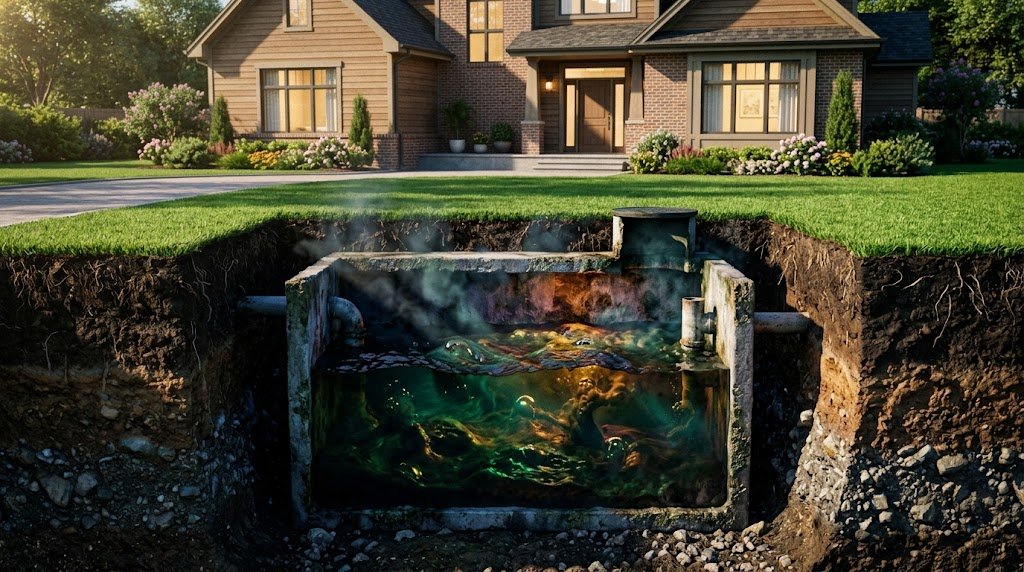
Introducing high-potency septic tank maintenance enzymes provides the exact biochemical response needed to liquefy waste. A home’s septic system operates silently beneath the grass until a sudden, horrifying failure occurs. One morning you flush the toilet, and instead of a clean, quiet drain, you hear an unsettling gurgle from the floorboards. Seconds later, a dark, foul tide creeps up through the shower drain.
A complete septic drainfield replacement averages between $10,000 and $25,000—a sudden financial blow that doesn’t even count the devastating cost of sanitizing flooded living spaces.Stopping a catastrophic septic failure doesn’t mean paying for constant mechanical pumping. Introducing targeted, high-potency biological catalysts like SEPTIFIX – The #1 Septic Tank Treatment provides the exact bio-chemical response needed to liquefy waste and shield your home from total system failure.
                               THE PATH TO SYSTEM FAILURE

  Everyday Cleaners         Microbial Eradication         Sludge Accumulation         Drainfield Clogging
 [ Bleach / Quats ]  ───►  [ Dead Bacteria Strain ]  ───►  [ Rapid Layer Growth ]  ───► [ $20,000 Failure ]
Stopping a catastrophic septic failure doesn’t mean paying for constant mechanical pumping or tearing up your lawn. It’s about managing the invisible biochemical balance sitting in the tank right now. Septic systems depend on active biological catalysts to break down solid waste, liquify floating scum, and keep soil pores open in the drainfield.
When modern cleaning habits silently wipe out this subterranean ecosystem, sludge accumulates exponentially. Introducing targeted, high-potency biological catalysts—like the multi-enzyme formulas found in SEPTIFIX
—provides the exact bio-chemical response needed to liquefy waste and shield your home from total system failure.
The Invisible Crisis: Why Standard Septic Bacteria Die Off (And How Enzymes Intervene)
Beneath your lawn sits a dark, quiet bioreactor. When functioning properly, anaerobic and aerobic bacteria process organic solids around the clock, separating waste into three distinct, predictable layers:
- The Scum Layer: Floating fats, oils, and grease (FOG) forming a hard crust at the surface.
- The Effluent Layer: Clarified liquid suspended in the middle that steadily flows out to the drainfield.
- The Sludge Layer: Heavy, semi-solid organic matter settling at the base of the tank.
+-----------------------------------------------------------------------+
|                         TYPICAL SEPTIC TANK                           |
|                                                                       |
|  [ Inlet ]                                              [ Outlet ]    |
|     |                                                       |         |
|     v                                                       v         |
|  +---------------------------------------------------------------+    |
|  | ~ ~ ~ ~ ~ ~ ~ ~ ~ ~ SCUM LAYER (FOG) ~ ~ ~ ~ ~ ~ ~ ~ ~ ~ ~ ~  |    |
|  +---------------------------------------------------------------+    |
|  |                                                               |    |
|  |                   EFFLUENT LAYER (Clarified Liquid)           |    |
|  |                                                               |    |
|  +---------------------------------------------------------------+    |
|  | * * * * * * * * * * SLUDGE LAYER (Solids) * * * * * * * * * * |    |
|  +---------------------------------------------------------------+    |
+-----------------------------------------------------------------------+
Left uninterrupted, native bacteria continuously digest this waste. But modern living introduces aggressive, chemical compounds that decimate these delicate microflora, causing an invisible biological collapse long before your drains slow down.
Chemical Eradication: How Everyday Cleaners Destroy Natural Microflora
Most household cleaning products are engineered with a singular goal: destroy microbes. When these chemicals travel down your drains, they transform a thriving septic tank into a sterile, lifeless vault:
- Chlorine Bleach & Disinfectants: Pouring just two gallons of liquid bleach down the sink can wipe out an entire tank’s active bacterial population in a matter of hours.
- Antibacterial Soaps & Quaternary Ammonium Compounds: Triclosan and “quat” sanitizers linger in the tank, continuously suppressing bacterial growth and stopping new colonies from establishing.
- Caustic Drain Openers: Concentrated lye and sulfuric acid wreck the delicate pH balance (which needs to stay between 6.5 and 7.5) required for bacterial life, turning the effluent acidic and halting natural decomposition dead in its tracks.
When native bacteria perish, solid waste simply stops decomposing. The sludge layer builds up higher and higher until heavy solids spill past the outlet baffle into the drainfield—sealing soil pores with a water-resistant bio-mat and triggering irreversible system failure.
The Catalyst Effect: Why Enzymes Are Non-Living Boosters, Not Microbes
To rescue a struggling tank, you have to understand the fundamental difference between bacteria and enzymes:
Entity Definition:
- Bacteria are living, single-celled organisms that consume organic waste and reproduce over time.
- Enzymes are specialized, non-living protein structures that act as biochemical keys, locking onto complex organic molecules and snapping their chemical bonds to accelerate natural decomposition.
Enzymes don’t die from harsh chemical exposure the way living bacteria do. Instead, they act as non-living catalysts. An enzyme binds to a specific compound—like a dense fat or cellulose fiber—cleaves its complex bonds, and releases small, soluble bio-solids without being consumed in the process.
$$\text{Substrate} + \text{Enzyme} \longrightarrow \text{Enzyme-Substrate Complex} \longrightarrow \text{Product} + \text{Enzyme}$$
Flushing concentrated enzymes into a chemically damaged tank bypasses the long wait for bacterial colonies to recover. The enzymes immediately break down heavy bio-solids into simple sugars, amino acids, and fatty acids—preparing a rich, digestible food source for surviving or newly introduced bacteria to thrive on.
The Core 4: Septic Tank Maintenance Enzymes Required for Sludge Liquefaction
Generic hardware store additives often fail because they lack the targeted protein profiles needed to break down modern household waste streams. Complete sludge liquefaction requires four specific biological enzymes working in unison.
| Enzyme Class | Primary Target Substrate | Molecular Action Mechanism | End Product |
| Cellulase | Toilet paper, plant fibers, lint | Cleaves $\beta$-1,4-glucan bonds in insoluble cellulose | Soluble glucose molecules |
| Protease | Hair, meat waste, organic proteins | Hydrolyzes peptide bonds holding protein chains together | Peptides and free amino acids |
| Lipase | Fats, Oils, and Grease (FOG) | Hydrolyzes ester linkages in insoluble triglycerides | Glycerol and free fatty acids |
| Amylase / Pectinase | Starches, food residue, pectin | Breaks down $\alpha$-1,4-glycosidic bonds in starches | Simple maltose and dextrin |
Cellulase: Dissolving Toilet Paper & Plant Fiber Matrices
Modern toilet paper is engineered to maintain its structural strength when wet. Without sufficient cellulase, paper accumulates at the bottom of the tank, weaving a tough organic mesh that traps other floating debris. Cellulase snaps the rigid $\beta$-1,4-glycosidic bonds of cellulose, transforming fibrous paper into simple, water-soluble glucose that degrades in days.
Protease: Degrading Meat, Hair, and Complex Organic Proteins
Protein waste entering your system—from sink food scraps to shower hair and body tissue—possesses tightly folded peptide chains. Protease enzymes slice through these peptide bonds via hydrolysis, preventing rubbery, fibrous sludge masses from gathering at the base of the tank where natural microbes struggle to break them down.
Lipase: Neutralizing FOG (Fats, Oils, and Grease) Layers
The floating scum layer is largely composed of insoluble fats, butter, cooking oils, and lotion residues. Left unchecked, this layer thickens into a hardened crust that chokes the tank or sheds floating mats directly into your drainfield. Lipase cuts straight through the ester bonds of triglycerides, reducing thick grease into water-soluble glycerol and free fatty acids that anaerobic microbes consume with ease. septic tank maintenance enzymes
Amylase & Pectinase: Breaking Down Starches and Complex Carbohydrates
Starches from kitchen garbage disposals—potatoes, rice, pasta, and food starches—pose a unique threat to system flow. Amylase breaks down complex starch polymers into simple sugars, while pectinase dissolves plant gel matrices. Together, they prevent starch gelation, which can otherwise turn effluent thick and gummy, choking the system’s internal fluid dynamics.
Bacterial Inoculation vs. Enzymatic Acceleration: Which Does Your Tank Need?
When your plumbing starts showing signs of distress, picking the right treatment comes down to diagnosing what’s happening deep inside your tank.
                          SEPTIC SYSTEM DIAGNOSIS
                                     |
               +---------------------+---------------------+
               |                                           |
      System In Distress?                        System Stable?
   (Odors, Slow Drains, Bleach)                 (Routine Preventive)
               |                                           |
               v                                           v
   ENZYMATIC ACCELERATION                      BACTERIAL INOCULATION
(Rapid molecular breakdown)                 (Long-term colony establishment)
The Enzymatic Fast-Track: Instant Breakdown vs. Sustained Bacterial Reproduction
- Bacterial Inoculation introduces billions of dormant spores (Bacillus strains) into the system. These spores require gentle conditions—balanced pH, stable temperatures, and zero chemical toxins—along with 24 to 48 hours just to wake up, colonize, and begin producing their own enzymes.
- Enzymatic Acceleration introduces active protein catalysts straight to the waste. The reaction begins the instant it hits water. Enzymes immediately cleave organic polymers into micro-fragments, completely independent of oxygen levels or pH imbalances that would kill living bacteria.
[Complex Organic Waste]
          │
          ├──► (Protease)  ──► Amino Acids  ──────┐
          ├──► (Cellulase) ──► Glucose      ──────┼──► [Digestible Food for Native Bacteria]
          ├──► (Lipase)    ──► Fatty Acids  ──────┤
          └──► (Amylase)   ──► Simple Sugars ─────┘
If your tank is reeling from heavy household cleaner use or sudden shock loads, enzymes act as an immediate biological strike force—liquefying heavy solids so that bacterial colonies can safely colonize for the long haul.
Step-by-Step Maintenance Protocol to Stop Drainfield Clogging
Following a targeted maintenance schedule prevents solid carryover into the drainfield, keeping your soil open and protecting your system for years to come.
Step 1: Pre-Condition the System
Stop using caustic drain openers, bleach, and harsh toilet bowl tablets for at least 48 hours before treatment. Run warm water down your lowest household drain for a few minutes to flush lingering chemical residues out of the primary line.
Step 2: Apply the Core 4 Enzyme Formula
Flush your concentrated enzyme treatment down the toilet closest to the septic tank.
- Standard Dosing: Flush 16 oz of liquid enzyme concentrate or 1 water-soluble packet per 1,000 gallons of system capacity.
- Emergency Shock Dosing: Double the initial application if you notice slow drains, gurgling pipes, or faint outdoor smells.
Step 3: Enforce the Overnight Zero-Flow Window
Apply treatments late at night before going to sleep. Restrict all water usage for 8 to 12 hours. This gives active enzymes an uninterrupted window to digest scum and sludge layers without being washed straight out into the drainfield.
Step 4: Establish a Bi-Weekly or Monthly Maintenance Cadence
Keep up a steady biological routine to stay ahead of incoming household waste:
+-------------------------------------------------------------------------+
|                    ROUTINE BIO-MAINTENANCE TIMELINE                     |
|                                                                         |
|   Day 1: Initial Core-4 Enzyme Dose (Overnight Dwell Time)              |
|   Day 15: Secondary Enzyme Maintenance Dosing                           |
|   Day 30: Live Bacterial Inoculation (Re-establish Colonization)        |
|   Repeat Cycle Monthly                                                  |
+-------------------------------------------------------------------------+
Real Questions Homeowners Ask
Will adding enzymes mean I never have to pump my tank again?
No treatment can completely eliminate physical pumping forever. While high-potency enzymes slow sludge accumulation by turning solids into liquid effluent, inert materials like sand, micro-plastics, and heavy mineral sediment still sink to the bottom. Enzymes stretch the time between pump-outs significantly, but you should still have the tank inspected every 3 to 5 years.
Could these enzymes eat away at my PVC pipes or rubber seals?
Not at all. Unlike caustic sodium hydroxide or acidic drain openers, biological enzymes are non-corrosive, non-toxic, and generate zero heat. They interact exclusively with organic waste and are completely safe for PVC, ABS, copper, cast iron, and rubber gaskets.
How can I tell if my system is failing or just running slowly?
Sluggish drains across multiple sinks, soft gurgling sounds when toilets flush, and occasional foul odors near the tank location point to early sludge buildup or slow flow. However, standing water over your drainfield, sewage backing up into household fixtures, or persistent foul odors in well water point to structural or soil failure—and call for an immediate professional inspection.
Products / Tools / Resources
- SEPTIFIX Septic Tank Treatment: High-potency, slow-release oxygen and enzyme tablets designed to neutralize odors, break down heavy sludge layers, and treat system bacteria balance directly.
- Rid-X Septic System Treatment: Widely available powder, liquid, and dual-action gel formulas containing natural enzymes and bacterial cultures for routine monthly maintenance.
- Roebic K-37 Septic Tank Treatment: A specialized biological formulation tailored specifically to prevent sludge buildup and restore septic tanks running under heavy household waste loads.
- Main Line Cleaner Bio-Enzyme Treatments: Non-corrosive drain lines and main-stack bio-enzymes engineered to digest FOG and organic buildup before waste even reaches the main inlet baffle.
- In-Line Effluent Tank Filters: Protective plastic mesh filters installed on the septic tank outlet baffle to physically catch floating bio-solids before they can reach the drainfield.