how to eliminate septic tank odors naturally. There’s a very particular kind of gut-drop that happens when you step out onto your porch on a quiet morning, expecting fresh air, and get hit instead by the heavy, unmistakable stench of raw sewage.
Your mind races immediately to the worst-case scenarios. Is the tank failing? Did the drain field collapse? Am I looking at a ten-thousand-dollar bill? You rush inside, check the basement, peer into the downstairs guest bath, and suddenly feel like your home is harboring some kind of invisible biohazard.
Here’s the dirty secret the traditional plumbing industry rarely shares upfront: A foul odor in your yard or around your tank doesn’t automatically mean your system is dead. More often than not, it’s a desperate chemical cry for help from a suffocating underground ecosystem. It’s a biological imbalance—a microscopic civil war beneath your grass where the wrong kind of microbes are winning.
If you’ve been trying to solve it with grocery store chemical deodorizers, dumping bleach down your toilets, or just bracing yourself for an expensive pumping service, you’re treating the symptom while starving the cure. Let’s look beneath the surface, unpack the actual biology of your tank, and walk through a permanent, natural blueprint to restore order, kill the smell, and protect your home.
The Root Cause: Why Septic Odors Mean Your System Is Suffocating
To understand why your yard smells like a municipal sewer line, you have to picture what’s actually happening down inside that dark concrete box buried in your lawn. A septic tank isn’t just a static holding vault; it’s a living, breathing biological processing plant.
When things are running right, it functions as an anaerobic digestion chamber where millions of microorganisms break down solid waste, turning heavy sludge into liquid effluent that safely filters out into your yard. But when modern life overwhelms the system—heavy chemical cleaners, excess grease, too much laundry detergent—that delicate biological balance shatters. The tank chokes off, loses its vital oxygen pathways, and starts venting toxic gases—primarily hydrogen sulfide, the classic rotten-egg smell—up through the soil, around your tank lids, and out near your plumbing vents.
Anaerobic vs. Aerobic Bacteria: The Biological Battle Inside Your Tank
Inside every septic tank, two distinct classes of microorganisms are constantly fighting for turf:
- Anaerobic Bacteria: These live and thrive in environments totally devoid of dissolved oxygen. While they’re necessary for the initial breakdown of heavy sludge, they’re notoriously slow, inefficient, and produce foul-smelling byproducts like hydrogen sulfide, mercaptans, and methane gas. When a tank gets heavy and choked with sludge, these gases leak out into the surrounding earth and air.
- Aerobic Bacteria: These need oxygen to survive and multiply, but they are absolute powerhouses of waste reduction. Aerobic breakdown is up to ten times faster than anaerobic decomposition, and best of all, it’s completely odorless. Aerobic bacteria liquefy waste down to nothing, stop thick scum layers from forming, and leave behind harmless byproducts.
When your yard smells like sewage, it’s a physical flashing light telling you your tank has tipped entirely into a stagnant, suffocating anaerobic crisis. The good bacteria are drowning, and the bad, sulfur-producing microbes have taken over.
The Hidden Danger of Masking Scents and Chemical Deodorizers
When you’re hit with a foul odor, the instinctual reaction is to grab a bottle of heavy chemical cleaner, a pine-scented deodorizer, or household bleach to “clean things out.” This is single-handedly the most destructive mistake you can make.
Harsh chemical deodorizers, chlorine bleach, and heavy antibacterial soaps don’t care about the difference between good and bad bacteria—they act like a biological carpet-bombing. When you flush those down your toilet, you wipe out whatever fragile active biomass your tank has left. Sure, your bathroom might smell like artificial spring rain for twelve hours, but you’ve effectively paralyzed your system’s ability to digest anything. Within a week, the organic load surges, your bacteria count drops to zero, and the sewage odor comes roaring back—pushing you one step closer to complete drain field failure.
The 4-Step Natural Odor Elimination Blueprint
Fixing septic odors for good means working with nature instead of trying to nuke it. By shifting the chemistry of your tank from a stagnant, suffocating bog into an active, oxygen-rich biological engine, you can neutralize odors at the molecular level in just a few days.
Step 1: Restoring Oxygen Balance with Bio-Active Tablets
The absolute fastest way to clear up septic odors naturally is to reintroduce dissolved oxygen and targeted, beneficial bacterial strains right down into the liquid layer of the tank.
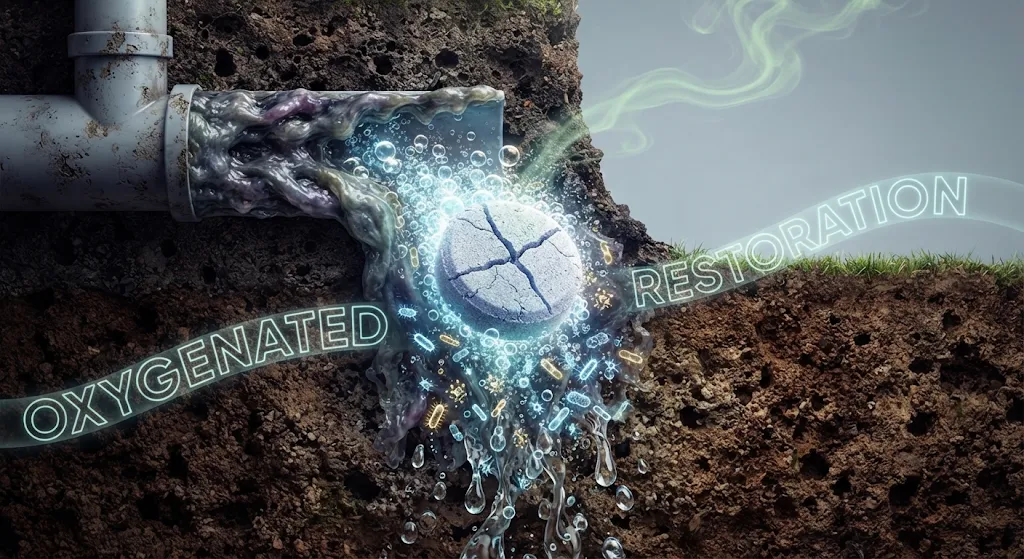
- The Mechanism: Advanced bio-active oxygen-releasing tablets dissolve slowly as they sink straight through the liquid column down to the sludge blanket at the bottom. As they break down, they release millions of oxygen molecules alongside billions of aerobic and facultative anaerobic bacteria strains.
- The Result: That sudden wave of oxygen instantly neutralizes hydrogen sulfide gas on contact, turning those foul-smelling sulfides into harmless sulfates. At the exact same time, the newly introduced aerobic bacteria go to work on the organic waste, rapidly chewing through the scum layer and cutting off the odor at its source.
Step 2: Flushing Out Drain Field Bio-Mats Safely
A lot of the time, that swampy sewage smell in your yard isn’t actually coming from the tank lid—it’s drifting up from the leach field itself. When grease, soap scum, and undigested organic solids manage to escape the septic tank, they form a thick, jelly-like seal in your drain field pipes and surrounding soil known as a bio-mat.
- The Mechanism: As this bio-mat seals off the earth, wastewater can no longer percolate downward. It pools underground or bubbles up to the surface, creating that unmistakable, wretched sewage smell right where you walk.
- The Action: Natural enzyme and bacterial treatments break down this biological slime from the inside out. By introducing specialized grease-eating and cellulose-digesting enzymes, the bio-mat is gradually liquefied, letting trapped water drain freely into the earth and silencing the surface odor.
Step 3: Inspecting Vent Stacks and Baffle Integrity
Even if your tank is biologically healthy, physical structural issues can trap gases and send them the wrong way.
- Plumbing Vent Stacks: Every home has roof vent pipes designed to safely shoot sewer gases high into the air above your living spaces. If those pipes get clogged by leaves, bird nests, or winter frost, household negative pressure will pull those gases right back down through your sink P-traps and floor drains, or force them out around your yard’s cleanout caps. Take a safe look at your roof vents to make sure they’re clear.
- Baffle Inspections: The inlet and outlet baffles inside your tank keep scum from escaping into the drain field and block gases from backing up into your house. A broken or rusted-out outlet baffle will let gas escape straight up your main sewer line instead of safely venting out your roof.
Step 4: Establishing a Maintenance Routine That Prevents Relapse
Septic systems run entirely on momentum. Once you’ve cleared the smell and brought the bacteria back into balance, keeping it that way comes down to a few simple habits:
- Regulate Harsh Cleaners: Try to ease up on heavy antibacterial hand soaps, bleach, and aggressive toilet bowl cleaners. Switch over to septic-safe, plant-based household detergents wherever you can.
- Monthly Bio-Inoculation: Drop a monthly oxygen-releasing bio-tablet into your toilet and flush. It keeps a steady army of active bacteria in play to handle your daily load of grease, food waste, and paper products.
- Mind the Trash: Never treat your toilet or garbage disposal like a garbage can. Stop flushing wipes—even the ones labeled “flushable,” which almost never break down—along with coffee grounds, grease, and paper products that don’t belong down there.
Natural vs. Chemical Treatments: What the Industry Hides
| Feature | Harsh Chemical Treatments & Bleach | Commercial Masking Scents | Bio-Active Oxygen Tablets (e.g., Septifix) |
| Primary Action | Kills all bacteria indiscriminately | Masks odor temporarily with perfume | Introduces oxygen & beneficial bacteria |
| Impact on Sludge | Zero effect; often hardens sludge | None | Actively breaks down sludge & scum layers |
| Drain Field Health | Destructive; clogs soil pores | None | Clears bio-mats and restores soil absorption |
| Odor Elimination | Temporary relief, long-term worsening | Hours to days of scent masking | Permanent neutralization at the molecular level |
| System Longevity | Accelerates tank wear and failure | Neutral | Extends time between pump-outs |
The traditional septic service industry often relies on a pretty cynical cycle: you ignore the system until it breaks, chemicals destroy the microbiome, you call for an emergency pump-out, and the whole expensive loop repeats. Shifting to an oxygen-based, natural maintenance model breaks that cycle cold. By keeping your system aerobically active, you slow down how fast solid sludge builds up, meaning you can safely stretch out the time between expensive professional pumpings while keeping your yard entirely odor-free.
Frequently Asked Questions
Why does my yard smell like sewage only after it rains?
Heavy rain completely saturates your drain field soil, raising the underground water table so water has nowhere to go. If your drain field is already struggling with a partial bio-mat clog, that trapped water forces septic gases and liquid waste straight up toward the surface, creating a sudden, brutal sewage smell right after a storm.
Will putting yeast or baking soda down the toilet fix septic odors?
It’s an old-school piece of plumbing folklore, but flushing yeast or baking soda doesn’t really do what people think. Yeast only feeds on simple sugars and won’t touch complex household waste, fats, or proteins. Modern bio-active oxygen tablets give you a scientifically balanced blend of enzymes and specialized bacteria strains engineered for heavy-duty waste breakdown.
How long does it take for natural treatments to eliminate yard odors?
When you use oxygen-releasing bacterial tablets, surface smells caused by dissolved hydrogen sulfide gas usually clear up within 24 to 48 hours as the oxygen neutralizes those sulfur bonds. Deeper drain field odor issues and bio-mat breakdowns generally take about 14 to 30 days of consistent biological work.
Products / Tools / Resources
- Septifix Oxygen-Releasing Septic Tablets: A specialized monthly tablet designed to dissolve at the bottom of the tank, releasing oxygen and aerobic bacteria to neutralize sulfur odors and break down sludge.
- Roof Vent Cap Screens: Simple mesh guards to prevent leaves, debris, and nesting birds from blocking your home’s main plumbing vent stacks.
- Septic-Safe Plant-Based Enzyme Cleaners: Everyday household and laundry detergents formulated to protect your tank’s fragile bacterial microbiome instead of wiping it out with harsh bleach or antibacterial agents.