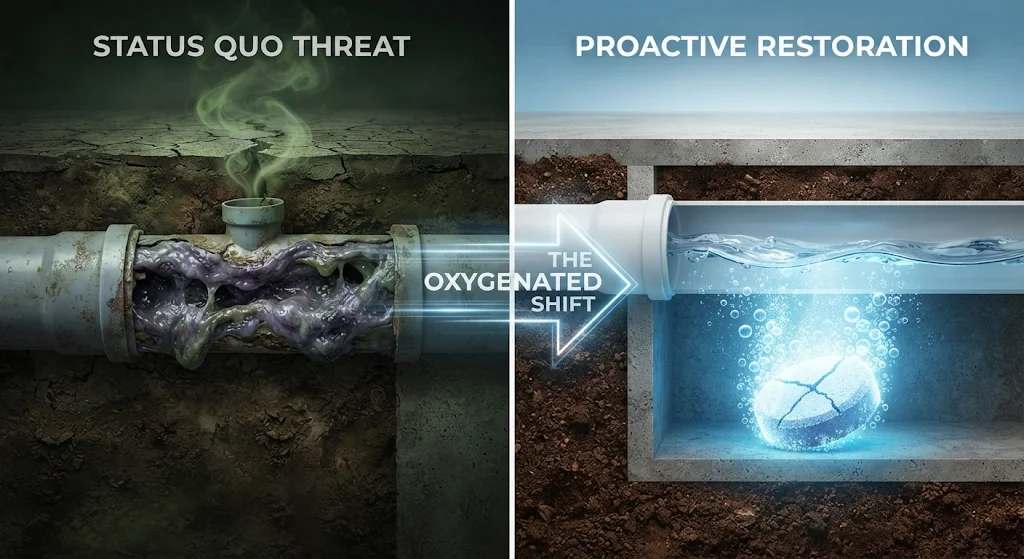
If you’re standing in the cleaning aisle staring at a familiar box of Rid-X—or hovering your cursor over the checkout button on a multi-month supply of Septifix—you’re really only asking one thing: Which of these actually prevents a $15,000 septic nightmare, and which one is just expensive peace of mind?
Every homeowner with a septic system lives under a quiet, underground threat. Out of sight, beneath the grass where your kids play or where you host weekend barbecues, a delicate biological engine is processing thousands of gallons of household waste every single month. When it’s running smoothly, you forget it exists. When it fails—choked by hardened cooking grease, suffocating anaerobic bacteria, or a sealed-off drain field—things get ugly fast. Raw sewage backing up into your downstairs bathtub. A yard smelling like an open municipal sewer. Excavation bills that can wipe out a family’s savings in a single afternoon.
Before you book your next $500 pump-out or commit to another year of monthly treatments, it pays to look past the marketing promises and weigh the actual chemistry, delivery mechanics, and long-term math of Septifix vs. Rid-X.
Quick Verdict: Septifix vs. Rid-X at a Glance (Cost, Speed, and Tank Protection)
Septifix is the stronger choice for fast sewage odor elimination, pH stabilization, and deep sludge reduction. It uses heavy, oxygen-releasing tablets engineered to sink straight down to the bottom sludge layer and release 14 strains of aerobic bacteria. Rid-X is the better budget-friendly option for basic, routine enzyme maintenance in an already-healthy tank, costing noticeably less per month through accessible retail powders, liquids, and pods.
| Comparison Metric | Septifix (Oxygenated Bio-Tablets) | Rid-X (Enzymes & Bacteria) |
| Delivery Format | 55-gram solid flushable tablets | Powder, liquid, or dissolvable pods |
| Primary Active Mechanism | Oxygen release + 14 aerobic bacteria strains + pH buffers | Cellulase, lipase, protease, amylase enzymes + bacteria |
| Where It Works in the Tank | Sinks through liquid to the bottom sludge blanket | Disperses primarily through the upper/middle liquid zone |
| Monthly Cost | ~$8.17 – $11.50/month (bulk bundle pricing) | ~$4.99 – $7.28/month (retail box/multi-pack pricing) |
| Odor Elimination Speed | Fast (24–48 hours via oxygen neutralizing hydrogen sulfide) | Gradual (2–4 weeks via slow enzymatic digestion) |
| Where to Buy | Direct from manufacturer website only | Big-box stores, hardware stores, Amazon, Walmart |
| Money-Back Guarantee | 60-day full refund guarantee | Standard retail store return policies |
Winner for Immediate Sewage Odor Elimination
Winner: Septifix.
When a septic tank starts smelling like rotten eggs, it’s suffocating from a buildup of hydrogen sulfide gas—the foul byproduct of oxygen-starved anaerobic bacteria. Because Septifix tablets release pure dissolved oxygen as they break down at the bottom of the tank, they oxidize and neutralize sulfur gases on contact. Rid-X doesn’t contain oxygenating compounds; it relies strictly on biological digestion, which takes weeks to gradually shift a tank’s odor profile.
Winner for Budget-Conscious Routine Maintenance
Winner: Rid-X.
If your septic system is relatively new, hasn’t shown a hint of odor or slow drains, and just needs a monthly enzymatic boost to help chew through toilet paper and everyday kitchen oils, Rid-X is hard to beat on upfront price. At roughly $4.99 to $7.28 per monthly dose depending on whether you grab a multi-month powder box or liquid bottle at the store, it costs noticeably less than Septifix’s ~$8.17 to $11.50 monthly bundle rate.
Deep Dive Into Ingredients and Microbiome Impact
To see why these two treatments behave so differently once you flush them, you have to picture the hidden architecture of a septic tank. Inside that buried concrete or fiberglass box, waste naturally separates into three distinct layers: a floating scum layer of fats, oils, and grease at the top; a middle effluent zone of liquid wastewater; and a heavy, compacted sludge layer resting on the floor.
How a treatment reaches those zones—and the chemistry it carries with it—decides whether it actually protects your drain field or just floats harmlessly near the surface.
Analyzing Septifix’s Oxygenating Formula and pH-Balancing Minerals
Septifix treats your septic tank like a biological life-support system rather than a simple digestive aid. Each 55-gram tablet is weighted to drop cleanly past the floating scum layer and settle directly onto the dense sludge blanket at the bottom of the tank.
- Sodium Carbonate & Oxygen Release: Once submerged, the tablet reacts with water to release up to 10 liters of dissolved oxygen alongside sodium carbonate. Modern households constantly flush acidic cleaners, laundry detergents, and antibacterial soaps that drag tank pH down and stall bacterial reproduction. These pH-balancing minerals neutralize that acidity, creating a stable, alkaline-neutral environment where beneficial microbes can actually thrive.
- 14 Aerobic Bacteria Strains: Unlike sluggish anaerobic microbes, aerobic bacteria consume organic waste up to ten times faster—and they do it without producing foul-smelling sulfur gases. By flooding the bottom sludge layer with both oxygen and billions of active aerobic bacteria, Septifix accelerates the liquefaction of solid waste before it can escape into your leach field.
Analyzing Rid-X’s Cellulase, Lipase, and Protease Enzyme Profile
Rid-X takes a very different, enzyme-first approach—essentially sending in specialized proteins that act like microscopic scissors to snip large waste molecules into smaller fragments your tank’s native bacteria can digest.
- Cellulase: Breaks down tough cellulose fibers from toilet paper, paper towels, and vegetable scraps.
- Lipase: Targets fats, cooking oils, and grease so they’re less likely to congeal into stubborn pipe clogs.
- Protease: Digests protein-heavy waste from food residue and human waste.
- Amylase: Converts complex starches and carbohydrates into simple sugars.
While Rid-X’s enzyme quartet does a solid job breaking down incoming waste in the upper liquid zone, its powders and liquids tend to disperse near the top of the tank. Without an oxygenating agent or pH buffer, Rid-X’s bacteria still have to fight for survival in an oxygen-starved environment—meaning it struggles to penetrate older, compacted sludge sitting at the bottom.
The Economics of Septic Longevity: Can Either Product Replace Pumping?
Let’s clear up the single biggest misconception in septic care right now: No biological additive—neither Septifix nor Rid-X—completely eliminates the need for mechanical pumping.
Inorganic solids—grit, sand, synthetic microfibers from modern clothing, hair, and non-biodegradable debris—cannot be eaten by bacteria or dissolved by enzymes. Over the years, those materials settle at the bottom of your tank and have to be physically vacuumed out by a licensed pumper every 3 to 5 years, depending on tank size and how many people live under your roof.
Still, the speed at which organic sludge builds up between pump-outs changes your household math dramatically.
Measuring Sludge Accumulation Rates Over 12, 24, and 36 Months
In an untreated tank battered by household bleach and antibacterial soaps, organic solids pile up fast—often forcing homeowners into emergency pump-outs every 18 to 24 months at $400 to $650 a visit.
- With Rid-X (12–36 Months): Consistent monthly enzyme dosing helps keep incoming paper and grease liquefied, keeping a healthy tank on a normal 3-to-4-year pumping schedule. Over three years, you’ll spend roughly $180 to $260 on Rid-X.
- With Septifix (12–36 Months): By actively breaking down the bottom sludge blanket through aerobic oxygenation, Septifix reduces organic volume far more aggressively. Over three years (using the 18-month bulk bundle at ~$8.17 per tablet), you’ll spend roughly $310. If that extra ~$50 to $130 investment delays even one $550 pump-out by 18 to 24 months, Septifix pays for itself entirely—while keeping your yard completely odor-free in the meantime.
Avoiding a $15,000 Drain Field Replacement Through Proactive Oxygenation
The real financial disaster isn’t a $500 pump-out; it’s drain field failure.
When anaerobic sludge builds up too high inside your tank, undigested grease and suspended solids spill over through the outlet baffle into your perforated leach field pipes. Once there, they weave together into a thick, waterproof slime layer called a bio-mat. When a bio-mat seals off the surrounding soil, wastewater has nowhere left to drain. It pools across your lawn or backs up into your house, leaving you facing a full drain field excavation and replacement costing anywhere from $10,000 to $25,000+.
Keeping your tank environment aerobic and neutralizing acidic pH swings stops suspended solids from escaping the tank in the first place—acting like a $10-a-month insurance policy against a five-figure property nightmare.
Frequently Asked Questions About Switching From Rid-X to Septifix
Can I switch straight from Rid-X to Septifix without pumping my tank first?
Yes, without any issue. Both Rid-X and Septifix are 100% natural, non-toxic biological treatments. There are no harsh chemicals in either formula that will clash or cause a negative reaction. You simply stop your monthly Rid-X routine and drop in your initial 3-tablet Septifix starter dose.
Why do I have to flush 3 Septifix tablets during the first month?
Septifix uses an initial 3-tablet “shock dose” to quickly neutralize built-up hydrogen sulfide gas, rebalance acidic tank pH, and establish a dominant colony of aerobic bacteria directly on your existing sludge layer. Once that biological baseline is reset in month one, you only need 1 tablet a month to keep everything running smoothly.
Are both treatments safe for older concrete tanks and PVC pipes?
Completely. Neither product relies on caustic lye, sulfuric acid, or chlorine bleach. Both are safe for concrete, fiberglass, and plastic septic tanks, as well as modern PVC, cast-iron, and older clay sewer lines.
Why can’t I just pick up Septifix at Walmart or Home Depot like Rid-X?
Septifix is sold exclusively through its official website to keep costs down by cutting out retail distributor markups and ensuring fresh bacterial potency, backed by a direct 60-day money-back guarantee. Rid-X relies on traditional big-box retail distribution, which makes it convenient to toss into your grocery cart, though it leaves you limited to standard store return policies.
Products / Tools / Resources
- Septifix Oxygen-Releasing Septic Tablets: The direct-to-consumer monthly tablet engineered to sink to the sludge layer, release oxygen and 14 aerobic bacteria strains, and neutralize sulfur odors.
- Rid-X Septic System Treatment (Powder, Liquid, or Septi-Pacs): Widely available enzyme-and-bacteria maintenance formulas ideal for routine preventative care in healthy, odor-free septic tanks.
- Septic-Safe Plant-Based Household Cleaners: Biodegradable laundry detergents and dish soaps formulated without chlorine bleach or harsh antibacterial agents that wipe out your tank’s beneficial microbiome.
- Mesh Roof Vent Cap Screens: Simple, inexpensive guards that keep leaves, pine needles, and nesting birds from clogging your home’s main plumbing vent stacks and trapping sewer gases indoors.